* Les prix de nos produits sont sujets à changements sans préavis.
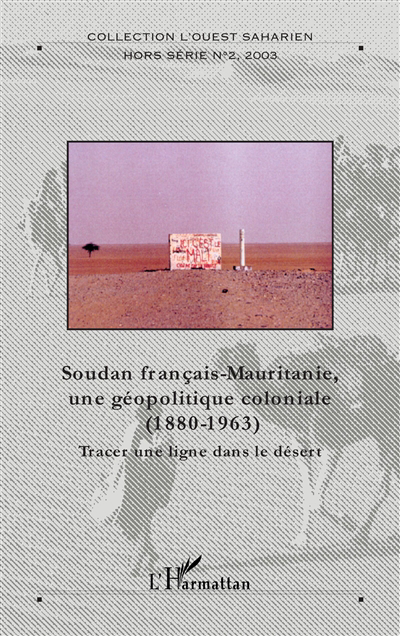
Etudiant la frontière soudano-mauritanienne, notamment par le prisme de sa rectification en 1944, l'auteur s'attache à analyser la formation d'une des limites des états africains à l'époque coloniale. Les bases du tracé et son arbitrage, ainsi que les conceptions qui ont présidé au découpage sont analysées.
Sudano-Mauritanian Colonial Geopolitics (1880-1963) . This work uncovers the history of a border in the middle of the Sahara, the history of a line drawn in the sand. What came to be at stake in the matter of this frontier which today separates the Republics of Mali and Mauritania? . Having studied many record archives and ancient maps, the author has analysed the administrative concepts and goals that governed the carveup, and attempted to understand how ancient pre-colonial boundaries were able to resurface through the deeds of exogenous actors. . The objective of the research presented here is to look at the concrete acts which gave form to the apparent abstraction of the frontier; to learn what the colonial administration expected of it, and to grasp how the autochtonous societies lived with it. . Revised in 1944 and today ratified by the states of Mali and Mauritania, was the course of the Sudano-Mauritanian frontier in the end justifiable? In this sense, Christelle Jus'work constitutes a new and important contribution to the historiographical debate about African frontiers. .